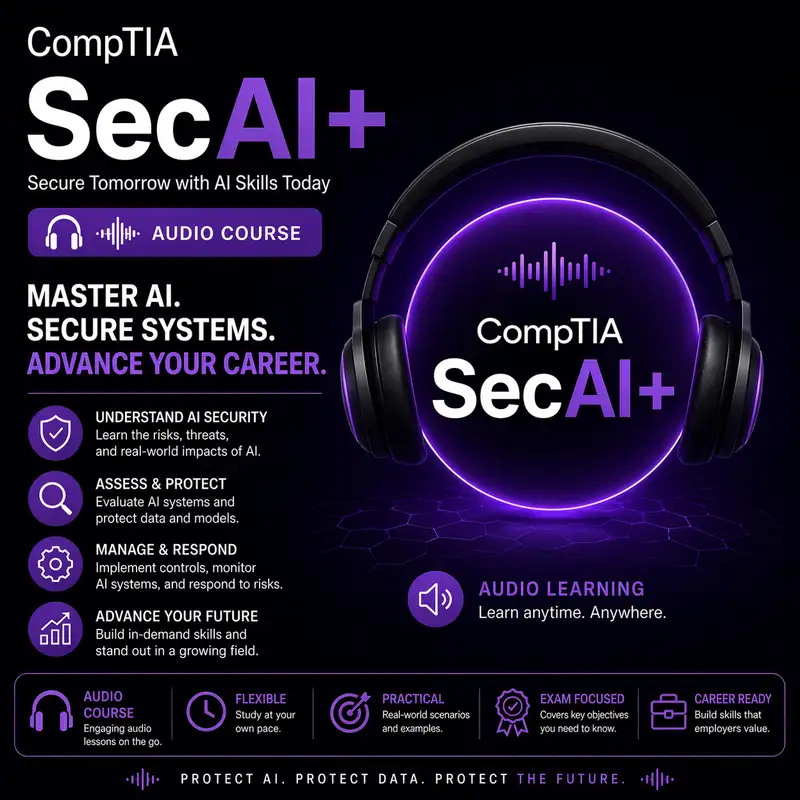
Certified: The CompTIA SecAI Certification Audio Course is an audio-first training program built for busy IT and security professionals who want to understand how AI changes cybersecurity work—and how security changes when AI is part of the environment. It’s designed for early- to mid-career practitioners, analysts, administrators, and technically curious managers who need a practical foundation without wading through research papers or hype. If you already speak basic security—identity, logging, vulnerability management, incident response—this course helps you connect those skills to modern AI systems in a way that makes sense on the job. You can use it as preparation for a CompTIA SecAI certification path, or as a focused upskilling track if your organization is adopting AI tools and you need to stay credible in the room.
Inside Certified: The CompTIA SecAI Certification Audio Course, you’ll learn how AI systems work at a level that matters for defense, governance, and risk decisions. We cover the security concerns that show up in real environments: data exposure, model misuse, prompt injection, supply-chain risk in AI components, access control for AI tools, and the operational controls that make AI safer in production. You’ll also build a working vocabulary for the space—models, training data, inference, embeddings, retrieval, and guardrails—so you can read vendor claims with a sharper eye and communicate clearly with engineers and leadership. The teaching approach is built for audio: short, focused explanations, plain-English definitions, and repeated reinforcement of the concepts you actually need to recall under pressure.
What makes Certified: The CompTIA SecAI Certification Audio Course different is that it treats AI security as security—not as magic and not as fear. You’ll get clear mental models, practical decision points, and the “why this matters” context that helps you choose controls instead of collecting buzzwords. Success looks like being able to walk into an architecture review and ask the right questions, map AI risks to familiar security practices, and recognize what good governance and monitoring should look like. It also looks like confidence: you can explain the difference between a data problem and a model problem, spot common failure modes, and recommend safeguards that are proportionate to the business use case. If you finish this course and feel calmer, sharper, and harder to mislead about AI security, it did its job.
Listen to the Trailer
Latest Episodes
Episode 90 — Prevent Shadow AI: Sanctioned Tools, Usage Rules, and Enforcement Patterns
This episode focuses on preventing shadow AI as a governance and data protection requirement, because SecAI+ expects you to control unapproved tools that employees ad...
Episode 89 — Apply Responsible AI Principles: Fairness, Transparency, and Explainability Choices
This episode teaches responsible AI principles in an exam-ready, security-relevant way, because SecAI+ expects you to translate fairness, transparency, and explainabi...
Episode 88 — Define AI Security Responsibilities: Owners, Approvers, Builders, and Auditors
This episode focuses on defining responsibilities clearly, because SecAI+ scenarios often reveal failures caused by vague ownership, where everyone assumes someone els...
Episode 87 — Build AI Governance Structures: Policies, Roles, and a Working Operating Model
This episode explains AI governance as an operating model that makes security and compliance achievable at scale, because SecAI+ expects you to choose governance struc...
Episode 86 — Manage CI/CD With AI Assistants: Secure Pipelines, Tests, and Change Control
This episode teaches how AI assistants fit into CI/CD without weakening security, because SecAI+ scenarios often involve AI-generated code, AI-suggested pipeline chan...